An optical illusion is any illusion that tricks the human visual system into perceiving something that is not there or into incorrectly perceiving something that in reality appears differently.

In the 1970s, Steve Simpson, a member of Richard Gregory’s laboratory, noticed something strange on the wall of a café at the foot of St. Michael’s Hill, a steep street in Bristol. The wall was covered with alternating black and white tiles, arranged in staggered rows and separated by a thin layer of gray mortar. The gray lines appear slanted, but if you cover the black and white blocks, you can see that they are actually straight.
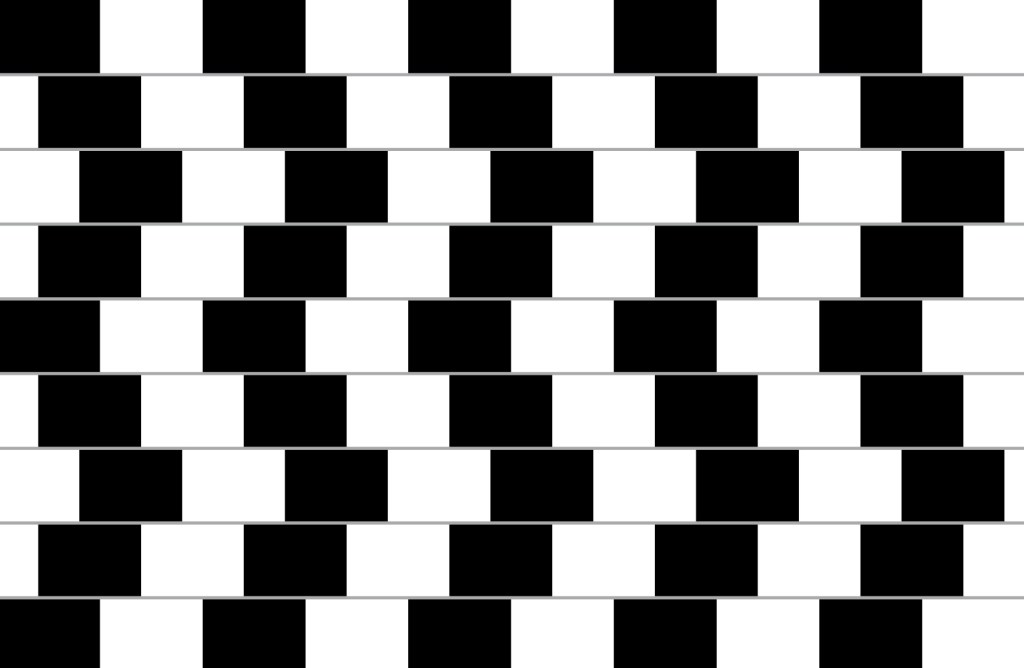
For this illusion to work, the blocks must be slightly offset from the bottom row, and the gray lines must be precise.
This illusion works because of the way neurons interact in the brain. The retina focuses on different parts of the gray lines depending on the position of the blocks. When there is a strong contrast between two blocks (such as black and white), the neurons interpret these changes as small imperfections. These imperfections are added together, making the lines appear slanted in a certain direction.
The offset between one row and the one below it is always the same: each tile is shifted half a step in the same direction. Therefore, the local arrangement around the gray (black at the top left, white at the bottom, and so on) is repeated identically in every corner along the row.
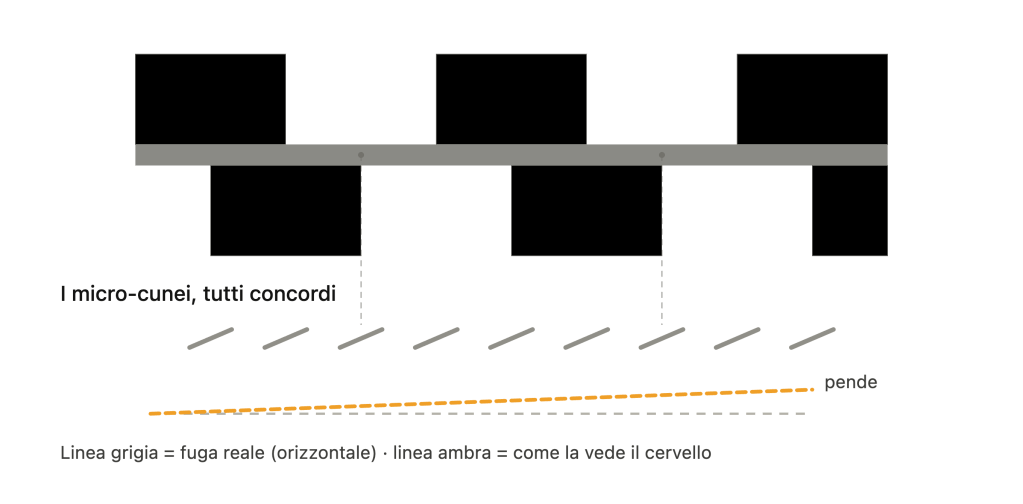
The next row is offset in the opposite direction to the adjacent rows, so its micro-wedges are tilted in the opposite direction.
 REAR 1898